There are now many portable devices which are powered by 9 Volt batteries such as mini CCTV cameras. While it is good that it is not necessary to use a 12V adapter and run cables to the device, the capacity of 9 Volt batteries is frustratingly low. Whether rechargeable or disposable batteries are used, they can often run out of energy within hours or days at best making frequent battery changes necessary for many devices.
AA Batteries as an Alternative to 9 Volt Batteries
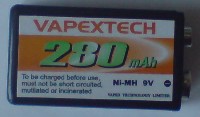
A typical rechargeable 9 Volt battery (such as the one pictured above) has under 300 mAh of storage. Compare this to the capacity of a good AA rechargeable battery at 2,900 mAh. If eight AA batteries are joined together in series the resultant battery has a capacity of 2,900 mAh at 9.6 Volts – therefore giving 10 times the capacity of a typical 9 Volt battery.
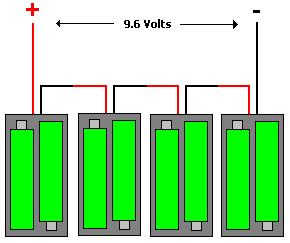
Using four 2 AA battery Holders to hold the batteries, series connection is simply a matter of connecting the positive lead from one holder to the negative lead of the next holder. The two remaining free leads are the outputs of the new high capacity 9.6 Volt battery. Below is an illustration of how this will look.
NEW – Please note that we now stock 8 AA battery holders in the REUK Shop which make this task simpler.
In order to connect the 8 AA battery battery bank to the 9 Volt battery powered device, a PP3 Battery Clip with flying leads is required – cost under 20p each.
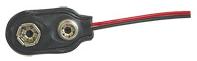
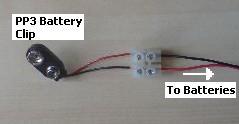
On a PP3 battery clip the red lead connects to the female connector, and the black lead connects to the male connector. On a 9 Volt battery, the male connector is +9V and the female connector 0V. Therefore , if we are to reproduce the polarity of a 9 Volt battery on the PP3 battery clip, the red lead of the clip must be connected to 0V from the battery bank (black lead), and the black lead of the clip must be connected to the 9V from the battery bank (red lead) as shown in the image below.
Regulating the Output Voltage
Each rechargeable AA battery has a nominal voltage of 1.2 volts – however, when fully charged voltages of 1.3 to 1.4 volts are typical, and voltages of 1.5V are possible when under charge. With eight fully charged AA’s in series, the total output voltage can easily reach 12 Volts. For devices which can also be powered by a 12 Volt mains adapter this is not a problem – internal electronics will cope with input voltages from 8 volts to 12.5+ volts. However, some devices are sensitive to the input voltage and could be damaged if powered by 10 or 11 volts. In these cases a simple voltage regulator must be built.
LM317T Voltage Regulator
Using an LM317T voltage regulator chip is one way of keeping the voltage entering the device to be powered at a fixed level. Full details on using the LM317T to regulate voltage in a circuit are available here. Just two resistors and an LM317T are all that is required – total cost around £1.
Zener Diode Regulator
Alternatively a zener diode for example an 8.2 or 9.1 Volt Zener can be used to supply a fixed 8.2 or 9.1 Volts to the device. Full details on making a Zener diode voltage regulator are available here. In this case just one resistor and one zener diode are required – total cost 10-20p – with the size of the resistor dependant on the current draw of the device to be powered.
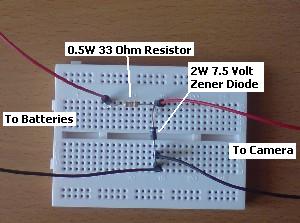
Pictured above is a zener diode voltage regulator for a mini CCTV camera. The camera can be powered by a 9V battery, but on its side is printed “use 6-7.5V DC adapter“. Therefore a 7.5V 2 Watt Zener diode was used with a 33 Ohm resistor to provide a fixed 7.5 volts to this 80mA device. The 10.8 Volts from the fully charged battery bank was correctly reduced to the required 7.5 volts by this circuit and neither the resistor nor the diode got hot during 30 minutes of operation – a good sign!
Low Dropout Voltage Regulators
When a NiMH rechargeable battery is nearly flat, its voltage can fall as low as 1.1 Volts. Therefore, with eight such batteries connected in series, the total voltage available would be just 8.8V. If an 8.5 Volt (for example) voltage regulator is required, then with the voltage dropped in an LM317 (as much as 2-3 Volts) or in a zener regulator, an unstable output voltage of below 8 Volts is likely well before the batteries are drained.
Where batteries are likely to be well drained, or in situations where the required voltage is close to 9 Volts, a low dropout regulator must be used. Such a regulator drops just 0.1 to 0.5 Volts and so even with virtually flat batteries, an acceptable output voltage can still be achieved.
NEW – Click here to view our new article: LM2941 1 Amp Low Dropout Adjustable Regulator for more information.
Solar Charging the 9 Volt Battery Bank
If you would like to charge the 9 volt battery bank, a 12V solar panel (or two 6V solar panels in series) will do the job. Voltage or current regulation may be necessary to prevent the batteries from being overcharged on very sunny days. Full instructions on this can be found in our articles Solar Battery Charging, Solar Battery Charging with LM317T, and Basic 4 AA Solar Battery Charger Plans.