In our articles Timer Circuits with 4060B, Repeat Timer Circuit we looked at how simple timers can be made which will control an output – e.g. something small like an LED, or a relay which can in turn switch absolutely anything.
For all but the very simplest of short time interval timers, a microcontroller is almost always the best approach to take. The number of electronic components and soldering required is minimal, and all the complexity is hidden in the code you write and download to the microcontroller. Changing the timings for example takes just a few seconds of re-programming with a microcontroller since no components need to be de-soldered/soldered and replaced etc.
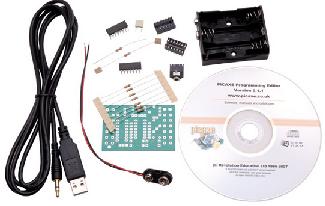
Learning to program microcontrollers is not actually very difficult – it just takes a bit of practice and a bit of reading. For an easy introduction to microcontroller programming for simple electronics projects we recommend PICAXE microcontrollers since they are low-cost, simple to program, easy to find, and require very few additional components. (When you get a bit more advanced and want to do more complex projects we would suggest Arduino may be the better option.)
One of the commonest things we are asked for is information on repeating relay timers – timers which are ‘ON’ for a while, then ‘OFF’ for a while, with that cycle repeating for as long as the timer is connected to the power – opening (ON) and closing (OFF) a relay which controls lighting, pumps, motors, sirens, etc. See our REUK Super Timer.
Automatic Repeating Timer PICAXE Basic Generator
If you have never programmed a microcontroller before and you would like to make a repeating relay timer, the following should be helpful. Enter the number of hours, minutes, and seconds for the ON and OFF periods for your desired timer, and the PICAXE Basic code will be automatically generated for you to use.
To get started all you will need is the following: PICAXE 08 Starter Pack (USB), and PICAXE 08M2 Chips, and visit our PICAXE Introduction for details on the official PICAXE website and forum, and to download the necessary software (PICAXE Programming Editor) to get your Basic code onto your PICAXE chip.