Greywater describes waste water which is a little bit dirty – for example, water which has been used in a bath or shower. Using a diverter valve, or syphon pump this water can be diverted from the waste pipe and used to water plants in the garden.
Filtering Greywater
Used bath and shower water can be used directly to water most plants without any problems at all. However, if this greywater is to be stored – for example to enable evening watering – or if it is to be used to water fruits and vegetables it should first be filtered.
When you take a bath, soap, shampoo, and other chemicals end up in the water together with your sweat, dead skin, hair, bacteria, and pathogens. If this cocktail is left in a waterbutt for a few hot summers days it will start to smell awful. Vegetables and other edible crops watered with the recycled water could be also be tainted.
Similarly it is a good idea to filter collected rainwater that you intend to store for a while since organic matter from the roof can be washed down the guttering and accumulate in your storage vessel.
Simple Domestic Greywater Filtering
A basic greywater filtration system can be made at home by anyone with limited DIY skills. Greywateris first passed through a coarse mesh filter bag.
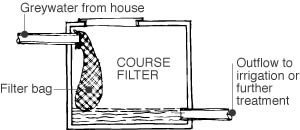
This removes any large particles such as lint and hair immediately. The greywater is then passed through a much finer filter to remove as many of the small particles as possible.
Greywater Sand Filter
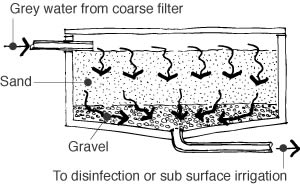
An example of a sand filter system is shown above. Basically it is made up of a thin layer of gravel topped off with a much thicker layer of sand within a waterproof container (old plastic dustbin, water butt, or barrel/drum). Coarsly filtered water passes through the sand being finely filtered as it goes before emerging at the bottom. The deeper the layer of sand, the better the filtration. An inline disk filterin the outlet pipe can be used to catch any last particles.
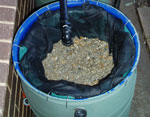
The filter described and illustrated in the paragraph above is a fast sand filter. Water passes quickly through the filter and small particles are removed. The sand in the filter needs to be washed quite regularly to remove accumulated particles from between the grains of sand.
Slow Sand Filter
A slow sand filter removes the tiniest particles from water – even smaller than the gap between the very fine grains of sand in the filter. A slow and constant flow of water through the filter described above leads to biological activity as the top layer of sand traps micro-organisms (e.g. bacteria and viruses). These micro-organisms digest disease-causing pathogens when they too get trapped in the sand. In time a bio-film builds up on top of the sand through which few pathogens can cross.
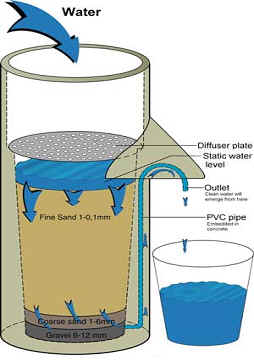
For a slow sand filter to work, the flow of water through it must be pretty much constant. A few hours without greywater and biological activity can cease as the biological layer become stagnant. Cleaning a slow sand filter is usually achieved by simple scraping off the top few centimeters of sand from the container.
Here is a video of a DIY rainwater harvesting slow sand filtration system, but the principle is the same for greywater:
Disinfecting Greywater
Water which has been filtered can be used to irrigate edible crops and can be stored a little bit longer than non-filtered water. For greywater to be stored for more than a day it must be disinfected – typically with chlorine or iodine to kill any pathogens which remain in it. A couple of tablespoons of bleach per gallon of stored water will do the job and the chlorine from the bleach will vaporise (evaporate away) in a couple of days.
This is not environmentally-friendly and definitely not good for the garden if chlorine concentrations build up, so greywater collected for garden irrigation should ideally be used immediately. Chlorine-treated greywater is best used for toilet flushing.
Click here for more information on disinfecting greywater.